Craig Springer

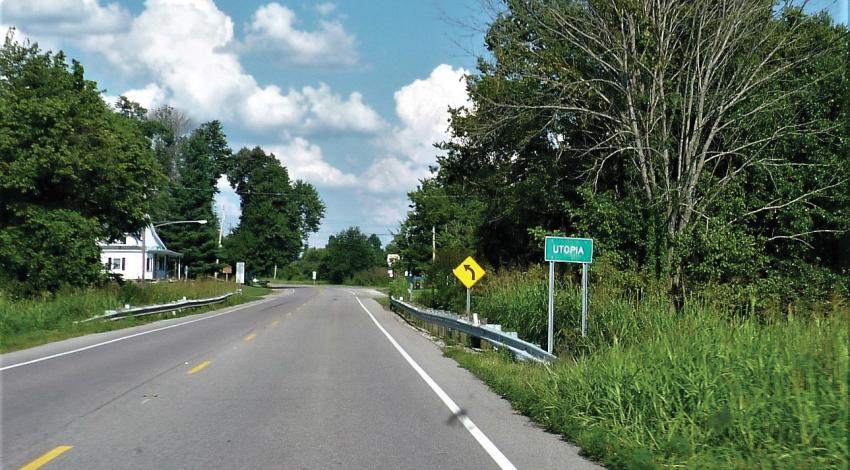
The road leading into Utopia, Ohio

Communes, seeing how they are often made up of individuals who possess a similar innate trait (generously called “self-interest”), always fail.

The first Utopia

In the 1830s, our still-new republic was a land of religious chaos. New denominations arose and populist movements formed as some folks grew disillusioned with the status quo or frustrated by economic woes. 

It was with that as the setting that French philosopher Charles Fourier’s views on communal living began to gain popularity: that everyone should share equally in both the work and the wealth of a community. Fourier-inspired communes called phalanxes began to spring up from New York to Texas.
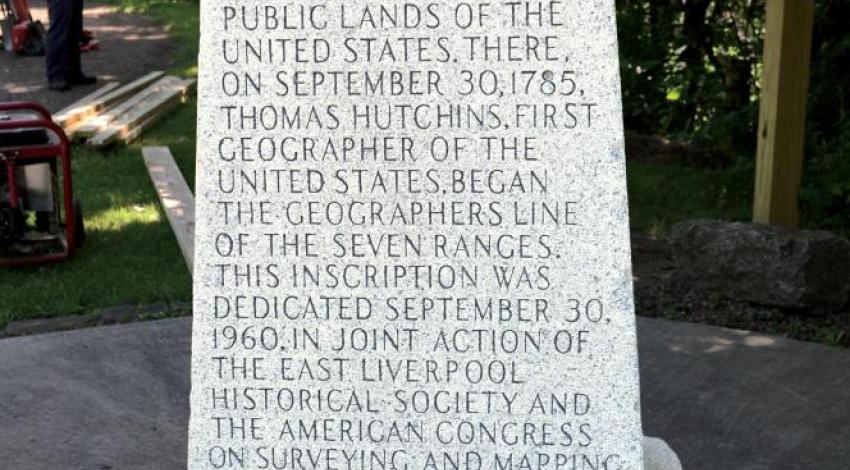
A monument in Ohio that commemorates three Jeffersonian ideals that were pivotal to the Land Ordinance

If you’ve ever flown over Ohio and points west, you cannot help but notice the checkerboard of farm fields and woodlots — the corn-and-soybean plaid that’s repeated westward until it finally exhausts itself at the edge of the Pacific Ocean.

In 1774, the Ohio Country was a vast land populated by a host of Native American tribes, and the British Crown wanted to use it as feudal property — owned by the king — where occupants would pay a tribute to live there. A young Thomas Jefferson was having none of it. He penned a pamphlet denouncing the plan — he hated the thought that only aristocrats and kings and churches could own land in America. More on that in a bit.

Historians note the April 1775 “shot heard ’round the world” — the opening round of gunfire when colonial Patriots engaged the British army for the first time during a skirmish in Massachusetts. 

It read, in part, “As the Love of Liberty, and Attachment to the real Interests and just Rights of America outweigh every other Consideration, we resolve that we will exert every Power within us for the Defence of American Liberty, and for the Support of her just Rights and Privileges; not in any precipitate, riotous, or tumultous Manner, but when regularly called forth by the unanimous Voice of our Countrymen.”

In today’s parlance, it might be described as a challenge to “fool around and find out.”

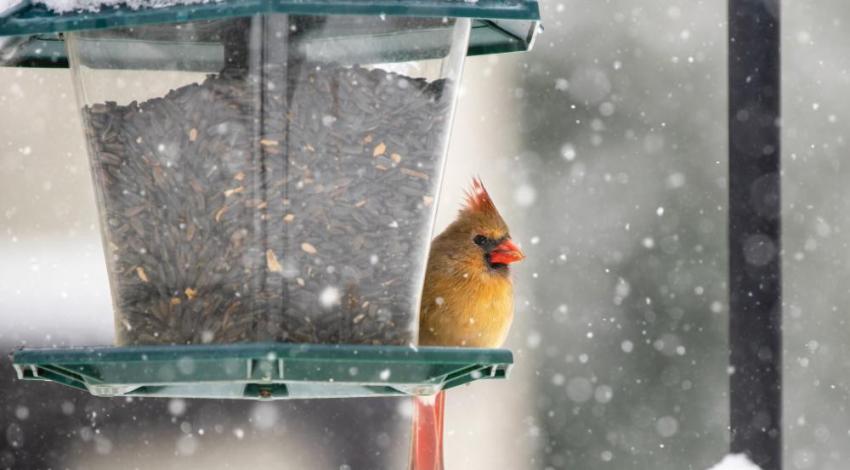
Female cardinal perched on a feeder

With its pointed crest and for its striking cardinal-red color alone, the northern cardinal is not only easy to notice, but also to remember and to appreciate. Lucky for us, it never leaves the home place.

The colorful northern cardinal lives over the entirety of Ohio, and that alone is reason enough for the state legislative assembly to name it the official state bird.  There are other meritorious reasons that call forth warm approval and high regard. 

A black and white photo of a person standing in front of a large boulder

Here’s a word lesson. Erratic: to lack a fixed course or uniformity; to wander or deviate from the ordinary. Now, let us apply that to Ohio’s geology, which is anything but ordinary. 

If you need a reminder that the world is held together by stone, then consider Ohio’s basement. You cannot see it except in the long strands of bored-out cores that have been extracted from hundreds of feet below the earth’s surface. The basement is composed of sedimentary rock, settled and compressed at the bottom of what was once a deep ocean. That bedrock dates to about 570 million years ago, geologists say. It’s called Cambrian period stone, named after Cambria (which is now called Wales), where the stone type was first described and given a name around 1835.

A painting of Constantine Rafinesque-Schmaltz

Constantine Rafinesque-Schmaltz is the scientist you did not know that you knew. His walkabouts through Ohio impressed upon him a desire to discover more about plants and fishes and a prehistoric culture that predated him by millennia. 

The family moved to Italy to escape the terrors of the French Revolution. It was there that a self-educated Constantine came of age and took an ardent interest in natural history and languages, which would come to have its consequences in the names of organisms — through the eastern U.S., in Ohio, and even into the American Southwest. 

Mistletoe

It’s the best time of the year — or so sings Burl Ives, over and over leading up to Christmas Day. Of course, cups of cheer (spiced cider, perhaps) will likely make an appearance, and (croons Burl) there may or may not be snow.

Like the Christmas celebration itself, hanging mistletoe in your house is rooted in ancient tradition. But before we get to that, it’s worth noting that mistletoe has no real roots — it’s a parasite, making its way in life by living off of rooted trees. “Mistletoe makes its own sugar, but poaches water from trees,” says Savannah Ballweg, who manages the Miami University botanical conservatory in Oxford.

According to Ballweg, Ohio is home to one species of mistletoe: American mistletoe, also known as oak mistletoe, found mostly in the southern part of the state.

A white house flying a Blue Star Flag

Ohio seems to have a bit of a thing with flags. It’s not just that our state flag is the only one out of the 50 that is not a rectangle (an interesting story in its own right).

You might have seen a service flag: a blue star (or stars) on a field of white, surrounded by a red border — hanging in the picture window of a seemingly random home in the neighborhood or in a shop window of a downtown building. But many folks might be unaware, or at least unsure, of its significance.

Daddy longlegs

The month of August is like an early Thursday morning of a given week: Just as Thursday means the week’s coming to a close, August marks the waning of summer.

That’s why they are also known as harvestmen — for their gregarious nature at harvest time. They live throughout Ohio, on the farm, in the forest, in the suburbs, in your gardens, and in every corner of every city. And they are good to have around.

It’s the dog days of summer, when the air is close and sultry and the heat oppressive. The nasally drone of insects that go sight unseen comes at you, swarming, rising and falling, lapping like waves that come and go off a lake shore. 

More than 2,400 species of fireflies exist around the globe, including about two dozen that make a home in Ohio. Fireflies, or lightning bugs as some people call them, are not flies at all, but beetles characterized by heavily armored shells over wings. 

When they take to the wing, they move about as though they carry a heavy load; speed through the air is not a defense mechanism. Heck, they advertise their whereabouts, from just above the grass to chest-high to weaving through the treetops, for any would-be predator to swoop in and make them a snack.