Sudden, severe storms can rake the Great Lakes at any time of year. But during one month in particular, the lakes — also known as the Five Sisters — are more fickle, violent, and deadly than usual, and Great Lakes sailors even have a name for the phenomenon: the Witch of November.
When an intense low-pressure atmospheric system descends upon the lakes during this time of year, its vast counterclockwise rotation draws in extreme wintry cold air from the Canadian Arctic to the north-northwest as well as warm Gulf air from the south. When those gigantic autumnal air masses collide, they can create hurricane-force winds that raise mountainous, murderous waves 30 feet high or more.
It’s not a great time for any vessel to be out on the lakes, and the Witch has claimed countless victims through the years.
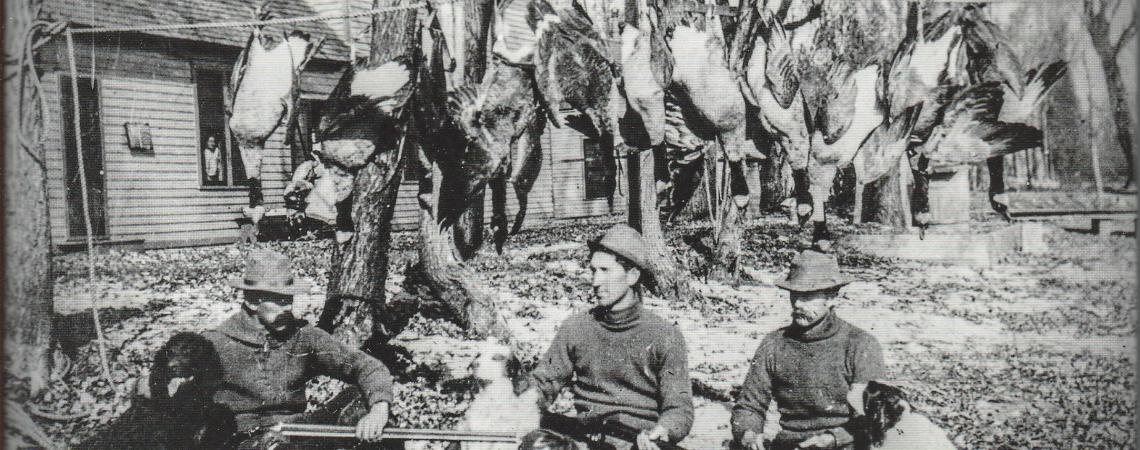
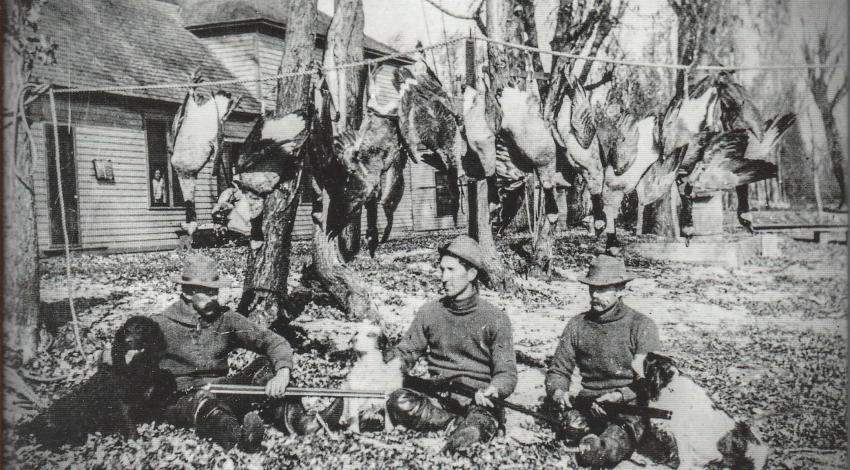
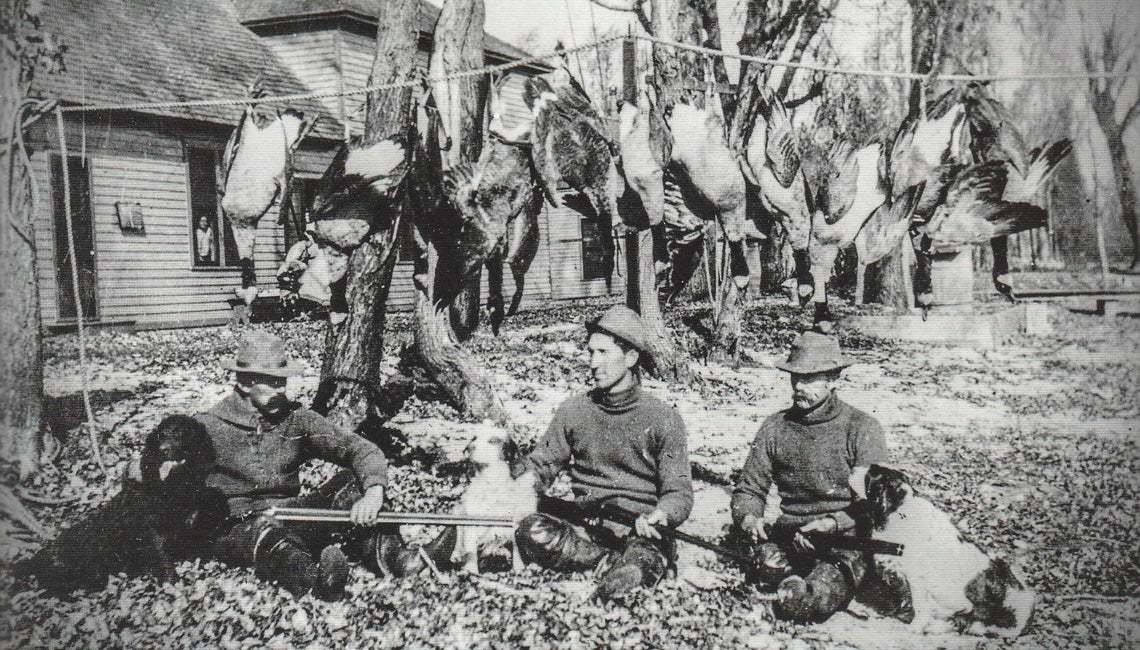
Waterfowl hunting guides and their dogs pose for a photo in front of the Pointe Mouillee Shooting Club clubhouse (photo circa 1900)
The Great Lakes Shipwreck Museum estimates that from 1875 to 1975, somewhere around 6,000 commercial ships sank on the Great Lakes — and those are only the ones that were documented. Some experts say the actual number could be more than four times that. Between one-fourth and one-third of them happened in November.
Thanks to advances in meteorology and maritime communications, thankfully, the number of commercial wrecks since 1975 has been exactly zero. But the dangers of navigating our inland seas during autumn remain, and the gales of November continue to test ships, captains, and crews on commercial and recreational ships alike. Mariners beware.
November 11, 1940: 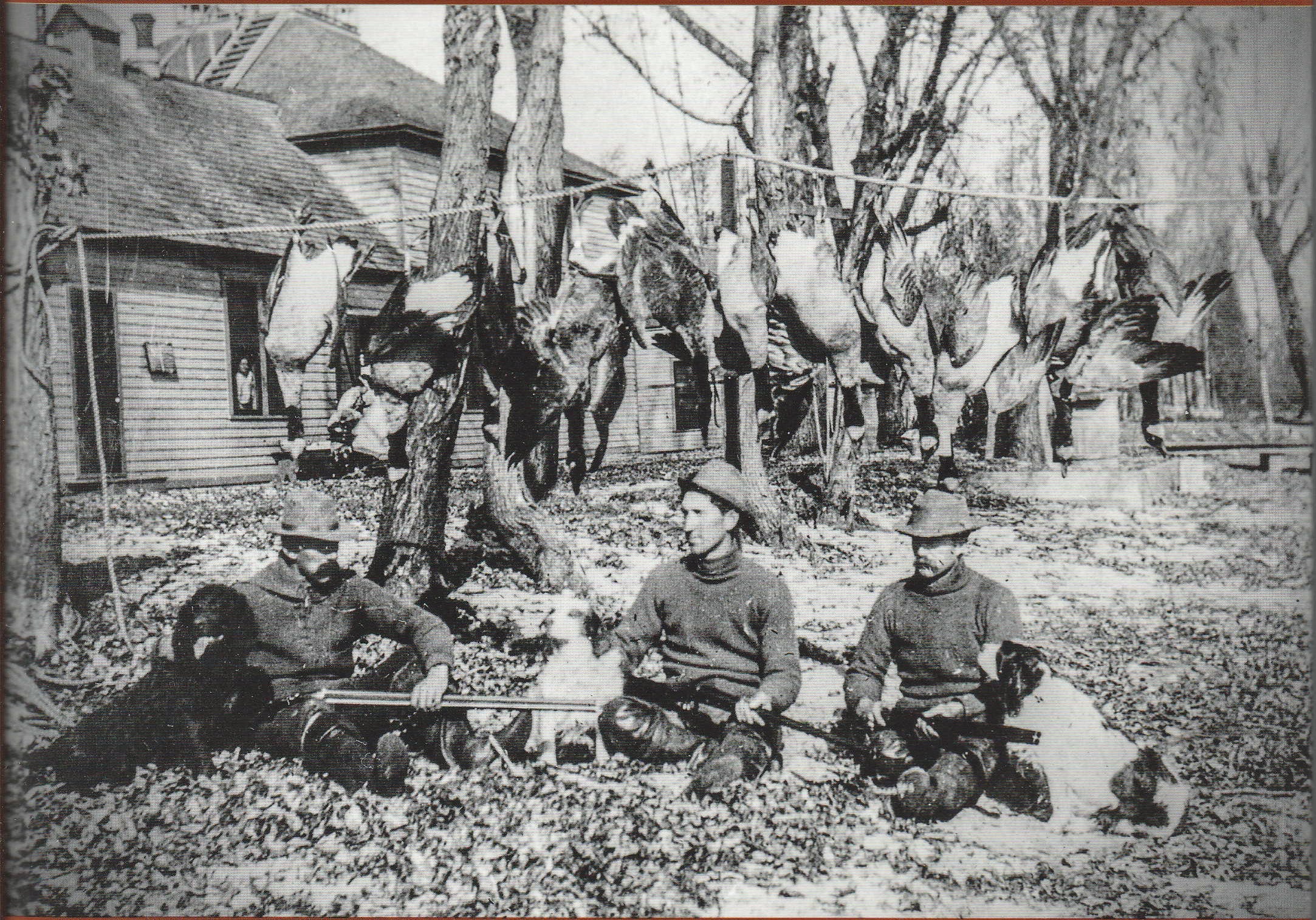
The day the duck hunters died
Since 1918, November 11 had been designated Armistice Day, marking the end of World War I. Congress made it a legal holiday in 1938, and as such, many sportsmen had chosen to go waterfowl hunting on that unseasonably warm Monday morning in 1940.
But rain started pouring down across the region about mid-morning, and those balmy temperatures from earlier plunged to just 10 degrees Fahrenheit in a matter of hours. The precipitation abruptly turned to sleet, then snow. Then came the wind — 20, 30, 40 miles per hour, then sustaining at 50 mph with gusts recorded in excess of 80.
On the eastern edge of the storm, members of the exclusive Pointe Mouillee Shooting Club were duck hunting in the Lake Erie marshes of southeast Michigan. Guide Ed Lezotte remembered, “We were all very lucky to make it back to the clubhouse. It was the worst day I’d ever seen on the marsh.”
Across half a dozen Upper Midwest states from Wisconsin to Ohio, 159 people died, most of them men and boys, mostly from drowning or exposure. But duck hunters were not the only casualties; some 66 sailors drowned as the freighters S.S. Novadoc, S.S. William B. Davock, and S.S. Anna C. Minch and at least two smaller ships went down in the storm.
November 29, 1966: 
Sinking of the Queen
In 1964, at age 24, Dennis Hale was living in Ashtabula, a small town along the Lake Erie shoreline. To support his wife and young family, he took a job as a crewman on the steamship Daniel J. Morrell, an ore freighter unofficially known (along with a sister ship built at the same shipyard) as the “Queen of the Lakes.”
“On November 28, the ship was making its way north in Lake Huron on its way to Taconite Harbor, Minnesota,” remembered Hale. “I went to bed about 10, but was awakened sometime the following morning by a very loud bang.”
Hale jumped out of bed wearing only a pair of undershorts, and grabbed a life jacket. As he stepped out onto the main deck, he couldn’t believe his eyes. “As I looked toward the stern of the ship, the boat had hogged (buckled upwards), the bottom had broken, and the midships was higher than the stern. Although it was still attached, I couldn’t see the rear of the ship.”
Of the 29 crewmembers aboard the Morrell, only Hale and three others made it to a life raft. For 38 hours they fought 35-foot seas and 65 mph winds; the air temperature was 33 degrees and the water 44 degrees. By the time the life raft was finally found by a Coast Guard helicopter 3 miles south of Huron City, Michigan, only Hale was still alive — the sole survivor. He needed multiple surgeries, but lived until 2015, when he died of cancer at the age of 75.
November 10, 1975: 
Immortalized in song
The most memorable Great Lakes shipwreck of all time was that of the ore carrier S.S. Edmund Fitzgerald. Measuring 729 feet from stem to stern — more than the length of two football fields — the “Big Fitz” was the largest ship on the Great Lakes when she originally launched in 1958.
She departed from Superior, Wisconsin, on November 9, 1975, bound for Detroit and laden with 26,000 tons of iron-bearing taconite ore. When a violent storm began pummeling the ship the next day, near Whitefish Point, Michigan, her captain, Ernest McSorley (one of 13 Ohioans on the 29-man crew), radioed, “We are holding our own.” Minutes later, the ship disappeared from radar, taking the entire crew with her to the bottom of Lake Superior, where her final resting place remains a protected grave site, restricted from all diving activities at the request of the families of the crew.
The tragic and mysterious story was later immortalized in a haunting song by Canadian singer-songwriter Gordon Lightfoot.
Ohioans on the crew of the Edmund Fitzgerald: Ernest M. McSorley (Toledo), master (captain); John H. McCarthy (Bay Village), first mate; James A. Pratt (Lakewood), second mate; Edward F. Bindon (Fairport Harbor), first assistant engineer; Thomas E. Edwards (Oregon), second assistant engineer; Bruce L. Hudson (North Olmsted), deck hand; Russell G. Haskell (Millbury), second assistant engineer; Karl A. Peckol (Ashtabula), watchman; Robert C. Rafferty (Toledo), steward; Paul M. Riippa (Ashtabula), deck hand; William J. Spengler (Toledo), watchman; Mark A. Thomas (Richmond Heights), deck hand; Ralph G. Walton (Fremont), oiler.
W.H. “Chip” Gross is Ohio Cooperative Living’s outdoors editor. Email him with your outdoors questions at whchipgross@gmail.com. Be sure to include “Ask Chip” in the subject of the email. Your question may be answered on www.ohiocoopliving.com!