wildlife

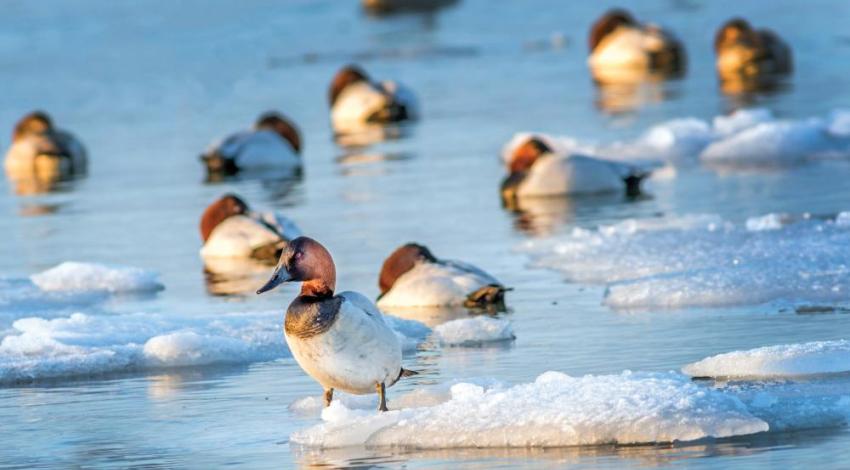
A photo of ducks in icy water

Decades ago, when I was a much younger man, I was a serious waterfowl hunter.

Large, handsome, fast-flying birds, canvasbacks were not exactly numerous during those years, but they were plentiful enough to be considered fair game. No matter how hard we hunted, however, we never bagged a single one. 

I retired from duck hunting and sold the boat decades ago, but in truth, I never totally lost the desire to bag a “bull can,” as hunters call the male (or drake) canvasback. Recently, I realized that I’m not getting any younger, and I decided that if I’m ever going to do it, I should probably do it soon. And I knew exactly where to begin my “hunt.” 

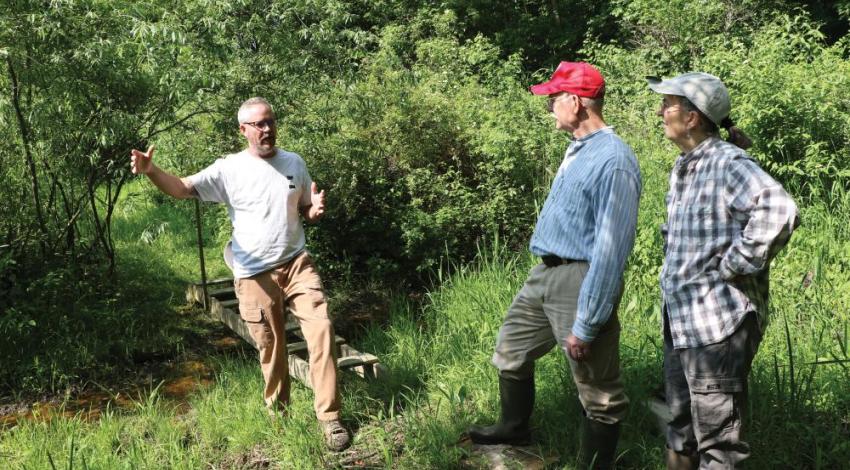
Three people talking in an outdoor space

With the exception of humans, likely no other species on earth can control its environment like the beaver. They do so, of course, by building dams — creating habitat not only for themselves but for other wetland wildlife species as well. 

The rodents are so large (weighing up to 60 pounds) and unrelentingly industrious (“busy as a beaver,” of course), sometimes it may seem their secret motto is “Dam the Humans!” 

Until recently, the main solution to beaver issues has been to do away with the beaver; eliminate the beaver and you eliminate the problem, or so goes the theory. But that kind of thinking is slowly beginning to change. Many rural landowners enjoy having beavers on their property, along with other wildlife their ponds attract — as long as the beavers and their dams can be kept under control. 

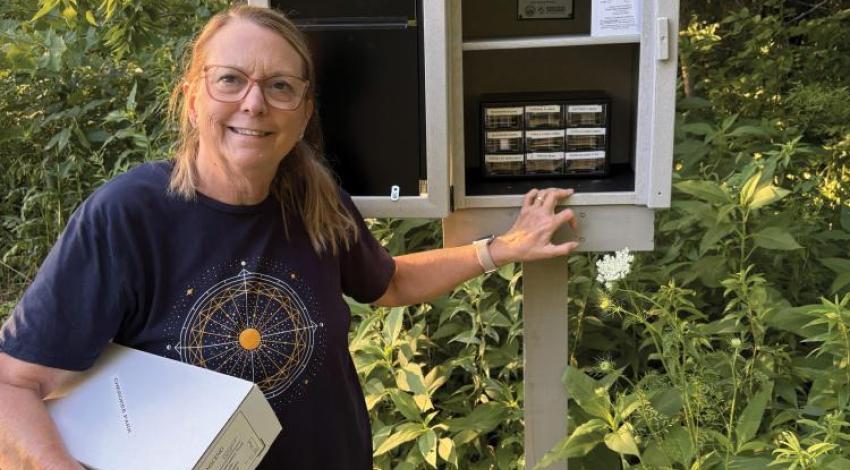
A woman standing with a community seed library

On a beautiful spring morning a few years ago, Randy Evans, director of Three Valley Conservation Trust in Oxford, was walking through a wooded area with the owner of the property, admiring the stunning array of wildflowers in bloom. 

Evans thought of all the Little Free Libraries that were springing up at the time, offering books for anyone to take, and thought that maybe a similar program might encourage more people to plant wildflowers. It was a project, he figured, that would fit right in with 3VCT’s mission. 

Three Valley Conservation Trust is a nonprofit group that promotes conservation measures in Butler, Preble, and Montgomery Counties. Its 250 members mainly work to secure land conservation easements and raise awareness of the importance of protecting natural habitats and resources. 

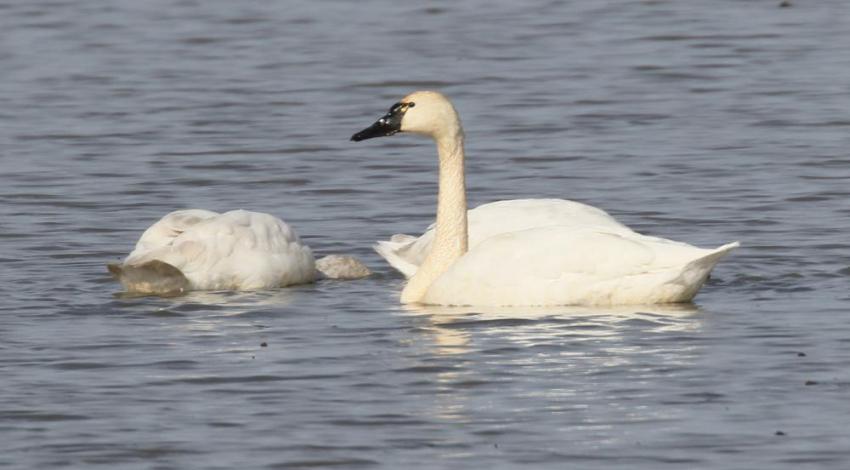
Tundra Swans in water

There are three categories of waterfowl that frequent the Buckeye State: ducks, geese, and swans. Swans are by far the largest of them — weighing 20 pounds or more, with wingspans measuring nearly 8 feet.

Tundra swan (the good)

The tundra swan is Ohio’s only native swan. Large flocks of them migrate through the state late in February and March on their way north to nest in the High Arctic, then come back with their young cygnets the following November and December, especially along the shores of Lake Erie.  If you have an older bird ID book, the tundra swan may be identified as a “whistling swan.” 

A black squirrel climbing down a tree

Gray squirrels are the bane of those of us who attempt to keep backyard bird feeders filled with birdseed. In large cities, small towns, and even rural areas across the Buckeye State, these arboreal aerialists seem to defy gravity in getting to places we don’t want them to be.

For instance, a very early Columbus resident and hunter shot 67 gray squirrels in one day from just one tree in the middle of a cornfield on what today is the Statehouse lawn.

A herd of buffalo in a field

Before the 19th century, wild buffalo (bison) dominated the North American continent — with individual herds covering 400 square miles or more and taking days to ride through on horseback. It’s estimated the bison population was more than 60 million at its peak. 

“Buffalo herds in the East were never huge, never teeming, never rivaling the truly vast herds that thundered across the Great Plains until the latter half of the 19th century,” Belue says. “Eastern buffalo herds often numbered 100 head or less, and droves of fewer than 20 were common.”

A group of lineworkers raising a nesting pole for a family of ospreys

Brad Bussard and his team are accustomed to working almost invisibly.

It was the end of May, the time of year when ospreys return to Ohio from their winter home in Mexico, and a breeding pair had decided that one of the utility poles in the training yard next to the co-op’s office was a good spot to build a nest. The population of ospreys, once nearly wiped out in the Buckeye State, has been steadily growing here since the Ohio Department of Natural Resources reintroduced them in 1996, to the point where the Division of Wildlife no longer even bothers to count them.

A black and white photo of a person standing in front of a large boulder

Here’s a word lesson. Erratic: to lack a fixed course or uniformity; to wander or deviate from the ordinary. Now, let us apply that to Ohio’s geology, which is anything but ordinary. 

If you need a reminder that the world is held together by stone, then consider Ohio’s basement. You cannot see it except in the long strands of bored-out cores that have been extracted from hundreds of feet below the earth’s surface. The basement is composed of sedimentary rock, settled and compressed at the bottom of what was once a deep ocean. That bedrock dates to about 570 million years ago, geologists say. It’s called Cambrian period stone, named after Cambria (which is now called Wales), where the stone type was first described and given a name around 1835.

Two butterflies resting on a flower

The 21-acre slice of the Hocking Hills on State Route 374, about halfway between Pine Creek and Laurel Run southeast of Rockbridge, has been in Christopher Kline’s family since 1863.

When Kline and his wife, Kris, members of Lancaster-based South Central Power Company, acquired the land, they weren’t sure exactly what they were going to do with it.

“We could cut for timber, but that didn’t seem fulfilling,” he says. Finally, they decided to fall back on what they know. Christopher has a master’s degree in plant biology from Ohio University and served as education director at the Grange Insurance Audubon Center in Columbus. He also was interpretation specialist at Franklin Park Conservatory, where he was known as “The Butterfly Guy.”

A starling chirping in the grass

Learning any hobby is always easier with a mentor — even a virtual one. Take birding, for example.

“The Merlin Bird ID app contains identification support and photos, sound recordings, maps, and descriptions for more than 10,000 bird species from around the world, with more species being added constantly,” says Kathi Borgmann, communications manager for the Cornell Lab of Ornithology, which developed and owns Merlin. “More than 29 million people worldwide have installed Merlin on their phones, with June 2024 seeing the greatest number of Merlin users, more than 5.4 million during that month alone.”