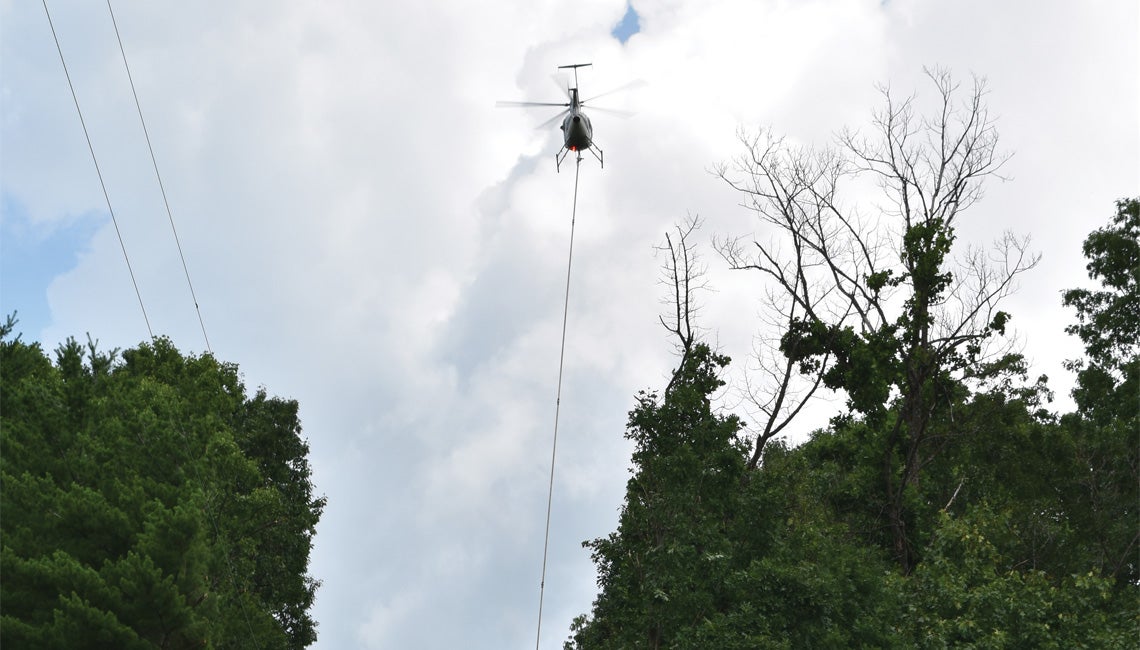
Some people might be alarmed by the sight of a low-flying helicopter dangling what looks like a prop in a horror movie passing over their property.
Nancy Thompson was excited.
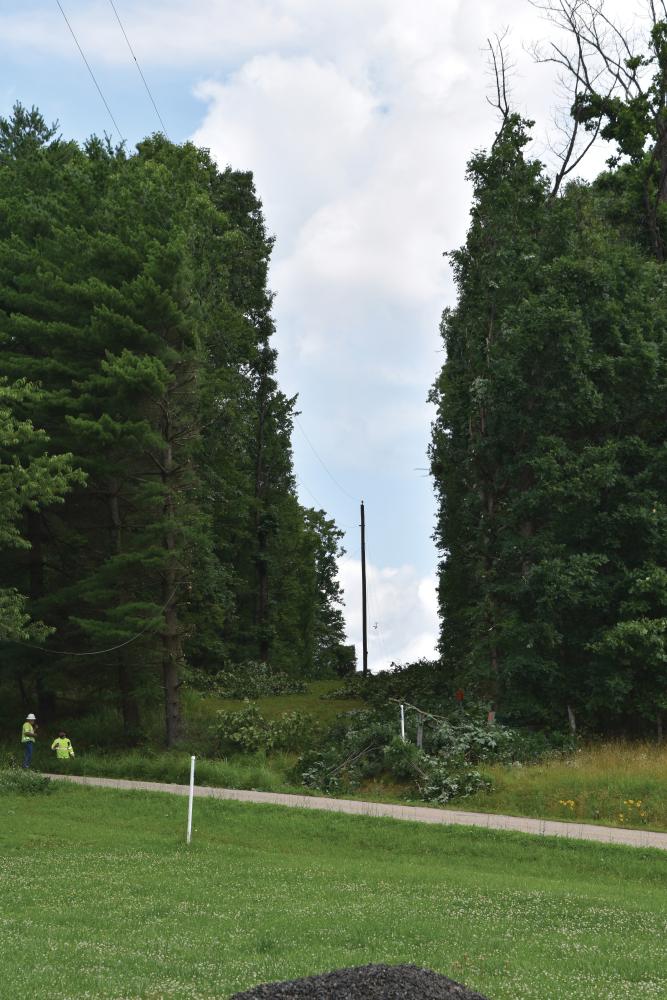
One muggy morning in late June, she stood outside watching as a contractor working for Marietta-based Washington Electric Cooperative flew his helicopter through a wooded ravine on Thompson’s farm in Whipple in rural Washington County, using an eight-bladed rotary saw hanging from his aircraft to trim trees away from the power line right-of-way.
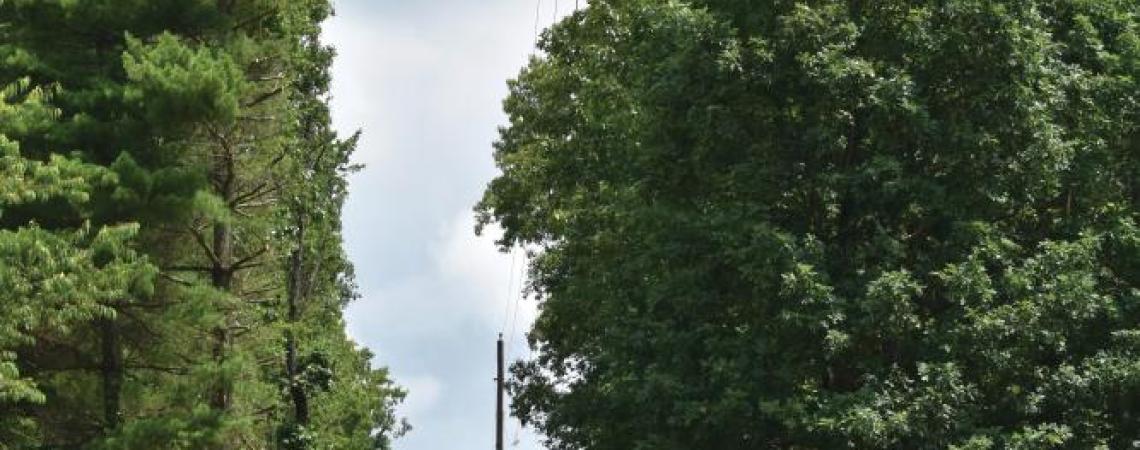
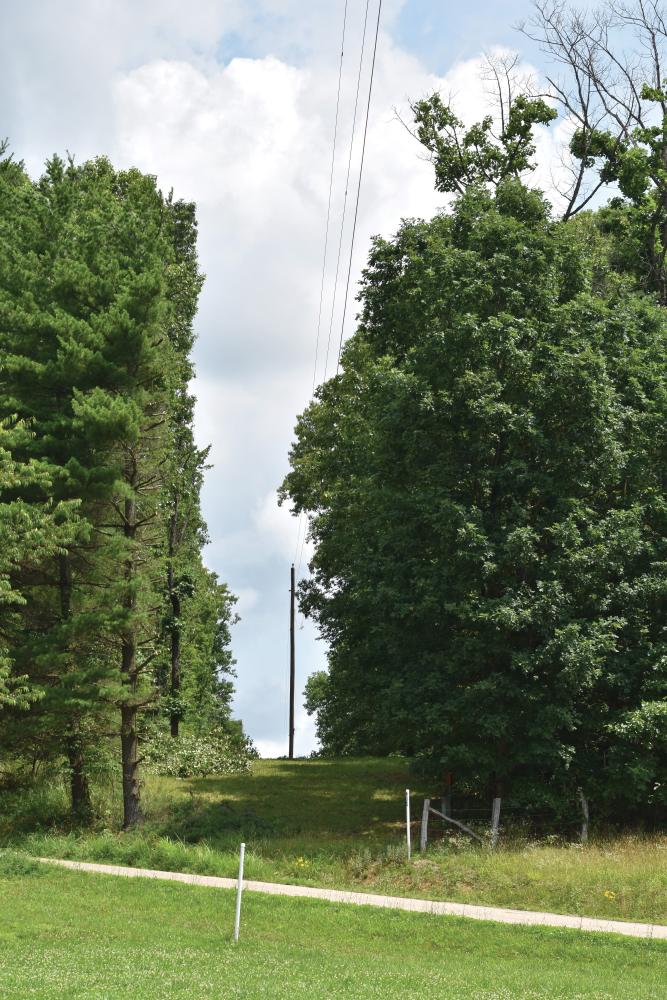
A right-of-way before trimming.
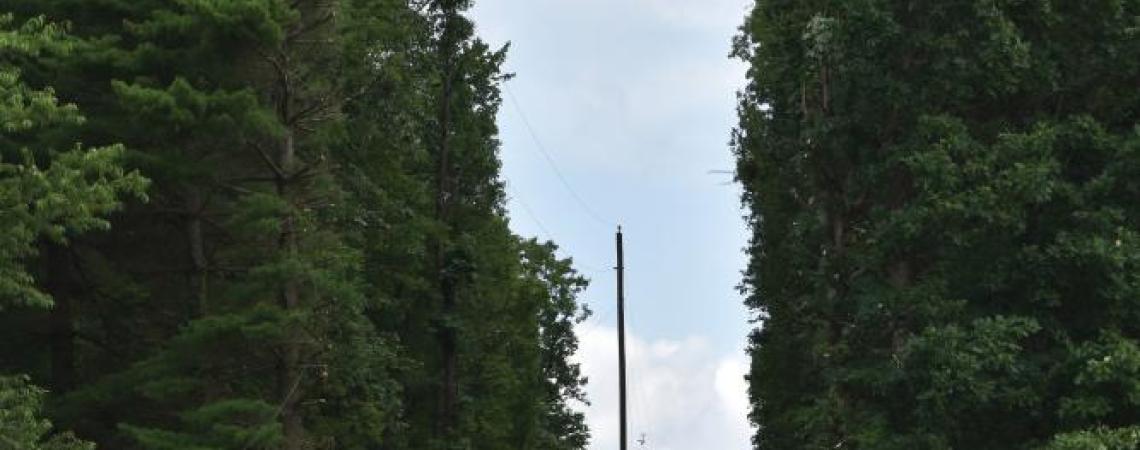
“Washington Electric called me last week and told me they would be here, and here they are,” she says. “I think it’s kind of exciting. They came through and cut the trees without cutting the wire. I’ve never seen anything like it.”
About 50% of all power outages are caused by vegetation. That figure varies widely depending on the landscape through which power lines run, and it reaches two-thirds for some Ohio co-ops. Many outages occur during storms when limbs or entire trees fall across electric lines, but others arise less dramatically when branches grow into lines.
So while different cooperatives employ different strategies for cutting and clearing trees and foliage from the areas around power lines, all co-ops share the same objective in managing that vegetation: to keep electricity both safe and reliable for their members.
A matter of responsibility
Ohio law requires electric utilities to maintain the safety of their lines, and that responsibility extends to private property, where co-ops have a legal “easement” providing permission to access lines on members’ property.
Whether they approach from the air or the ground, whether their employees do the work or they utilize contractors, co-ops generally work through their systems on multi-year rotations, employing various techniques of clearing, cutting, and spraying to keep lines up and power flowing to their members.
“We maintain a 40-foot right-of-way, which is 20 feet on each side of a power line,” says Kyle Cramblett, operations manager for Coshocton-based Frontier Power Company. “We do this to prevent outages, which can happen not just from trees falling onto a line, but from trees growing into a line. It’s also for the safety of the public, so electricity doesn’t arc into a tree where a child could be climbing.”
Additionally, Cramblett says, keeping rights-of-way clear allows co-op crews to more easily reach lines for repairs and maintenance. “If we have to put wires back up after a storm, it’s much harder to do if we have to cut through briars and brush to get to the lines.”
Different tactics, same objectives
Each of Ohio’s 24 electric distribution cooperatives has not only its own technique, but its own philosophy in managing their rights-of-way.
At Frontier Power, for example, employee crews do the right-of-way work, and time spent working ROW is a prerequisite for prospective lineworkers.
“All of our lineworkers have to start on our right-of-way crew,” Cramblett says. “They not only
learn proper tree cutting and vegetation control, but they also learn our whole system and how our maps work. When we fill a lineman position, we take candidates from our ROW department.”
At Washington Electric, the ROW heavy lifting — including tree trimming and herbicide spraying — is done by contractors supervised by the co-op’s operations department.
“It takes a lot of time, effort, and money to maintain rights-of-way,” says Kenneth Angle, operations foreman at Washington Electric. “We work to find the best and most cost-effective way to manage it for the short term and the long term.”
Aerial and ground approaches
Given the rugged, wooded territory typical of the eastern and southern portions of the state, including areas served by Washington Electric, those contractors often need a unique set of skills — as Nancy Thompson witnessed during that helicopter visit in June. “It’s like a huge cliff there, into that ravine,” Thompson says. “I don’t know how they could ever do it without a helicopter. I really appreciate all they do to keep my electricity on.”
In addition to providing access where ground equipment would have trouble reaching, a helicopter provides other advantages, Angle says. “The helicopter can clear from the ground to the sky without tearing up the ground, and it can do in minutes what could otherwise take days.”
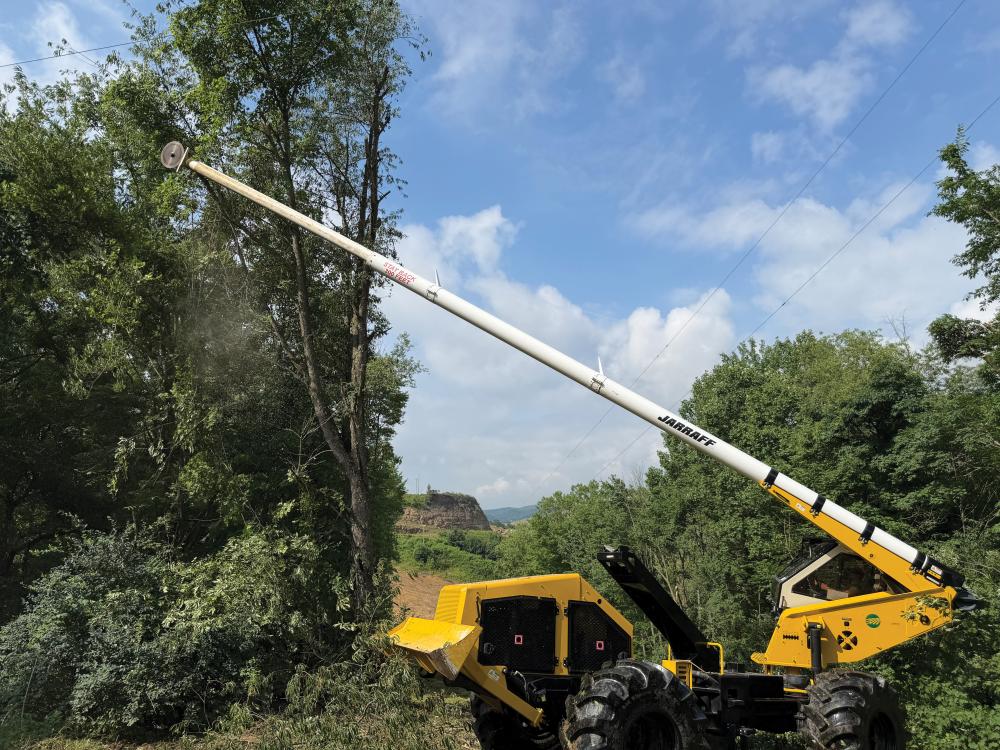
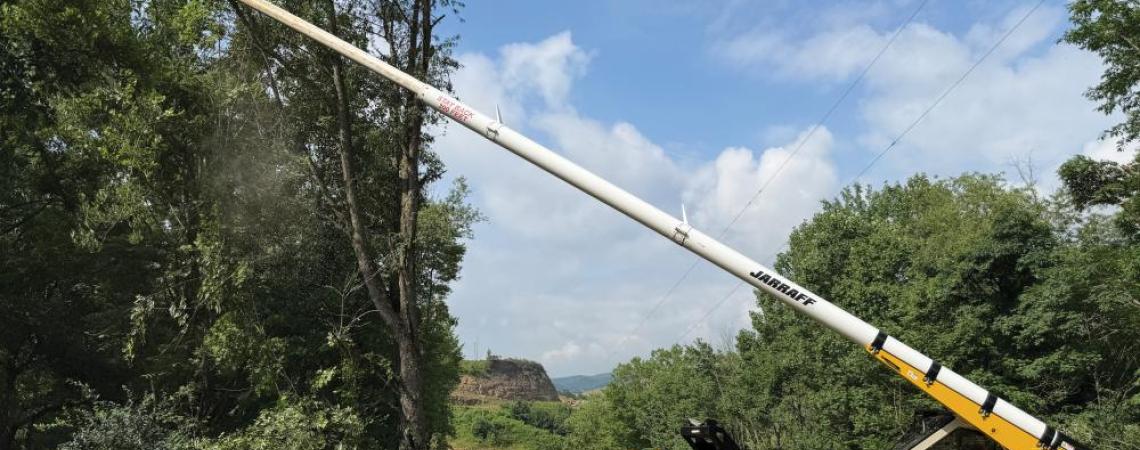
Meanwhile, Frontier Power’s employees use a combination of specialized equipment as they undertake a ground assault on vegetation in rights-of-way. “We do side-trimming with a Jarraff, which is like an industrial tractor with a 70-foot telescoping boom,” Cramblett says. “It can get us access into tough places, in many conditions, and it saves our guys from having to climb trees to side-trim the edges of the ROW.”
The Jarraff is followed by two different types of mowers, including a Fecon, which mulches the vegetation that has been trimmed, and a skid steer with a brush hog, a rotary-type mower, to tackle briars and smaller vegetation.
Keeping things clear
Once a section of right-of-way has been cleared, the challenge is to keep it that way. Crews spray herbicide to keep vegetation from growing back too quickly. “Herbicide gives us a few years before the woody vegetation starts to come back,” Cramblett says. “If we didn’t spray, we would have to double up how much trimming and mowing we do.”
Angle says the herbicide co-ops use is safe and encourages growth of grass and low-growing plants that support pollinators and wildlife. “It helps to create good habitat for deer to graze and for turkeys, and the way we cut the right-of-way, the brush along the sides gives small animals places to hide,” he says. “It’s a win-win for us and the varmints.”
Getting the job done
However cooperatives achieve vegetation management, they all want members to understand that the efforts are focused on meeting members’ needs and expectations.
“We’ve got a plan and a job to do,” Cramblett says. “When we do it, members are going to find that their power is more reliable down the road. When a storm comes through, there will be fewer outages and the duration will be a lot less when we’ve cleared the rights-of-way.”
A serious tree-sponsibility
While cooperatives’ vegetation management strategies focus on reliability and safety, another factor is important as well: preserving the abundant, healthy trees that members and communities value.
“We all have a priority for reliability and safety,” says David Tidd, arborist for Mount Gilead-based Consolidated Cooperative. “But we also do a lot of listening to our members about their concerns. We do what’s best for the trees while keeping in mind our goals.”
A key component is following industry best practices for trimming trees. “We adhere to the standards of the International Society of Aboriculture, in conjunction with the Utility Arborists Association,” Tidd says. “We also try to educate members about why we cut trees and why we use techniques like directional pruning, so trees grow away from power lines.”
Tidd, who has a bachelor’s degree in forestry and is ISA-certified as an arborist and utility specialist, works with members to find solutions agreeable to them and to the co-op.
“Communication is key,” he says. “Our work planner goes out ahead of crews, notifying members so they’re not surprised and so we can find the happy medium of how much we’re going to cut.”
Consolidated’s efforts have earned the co-op recognition as a Tree Line USA-certified utility through the Arbor Day Foundation, which promotes safe, reliable service and healthier forests.
Washington Electric Cooperative has the challenge of lines that go through the Wayne National Forest. “The national forest has its own rules, paying attention to the needs of wildlife and the health of the forest,” says Kenneth Angle, the co-op’s operations foreman. “We notify them any time we’re going to work in the forest. They understand what we need to do for our members and we understand that we have to be good stewards of the environment.”
All members benefit when co-ops do a good job managing their rights-of-way.
“With more bad storms recently, people are coming to understand the importance of vegetation management,” Tidd says. “No one likes to be out of power or without internet.”
Technological advancements
Ohio co-ops rely mostly on tried-and-true methods of vegetation management — following rotation schedules, trimming, mowing, and spraying on set timelines — but some technological tools may provide additional help in the future.
Co-ops can assess rights-of-way without sending personnel out to inspect all lines: for example, by using high-resolution satellite imagery for an up-close view from above, or LiDAR, which stands for “light detection and ranging” and gives exact, three-dimensional data about the shape of the surface around utility assets.
While they are promising options, both can be cost-prohibitive, says Joshua Smock, GIS and engineering specialist at Butler Rural Electric Cooperative in Oxford.
One technology application that’s more practical, especially for small- to medium-sized co-ops, is using drones with cameras to get views of lines and ROW areas, Smock says.
Butler, in fact, recently completed a program with Miami University geographic information systems students, performing drone-based inspections focused on mapping and evaluating utility rights-of-way. The partnership provided real-world experience for the students while helping the co-op evaluate the benefits of drone-based inspections.
Butler is now in the process of developing an ongoing drone program that will help with vegetation management and equipment inspection, among other benefits.
“You have a better view of the tree canopy from above than from below,” Smock says. “Drones can help us see any encroachment of trees in the right-of-way that could cause problems.”
Additionally, drones allow access to hard-to-reach places. “It’s faster and cheaper to send someone to scout with a drone in areas that might not be easily accessible for crews on the ground,” Smock says.
What happens when trees meet power lines?
When branches or limbs touch energized lines, several problems can occur:
- Momentary contact can cause blinking lights or voltage fluctuations
- Sustained contact can result in a full outage
- Broken limbs can pull lines down, creating dangerous conditions.
Even when an outage doesn’t occur immediately, repeated contact weakens equipment and increases the risk of future failures.